


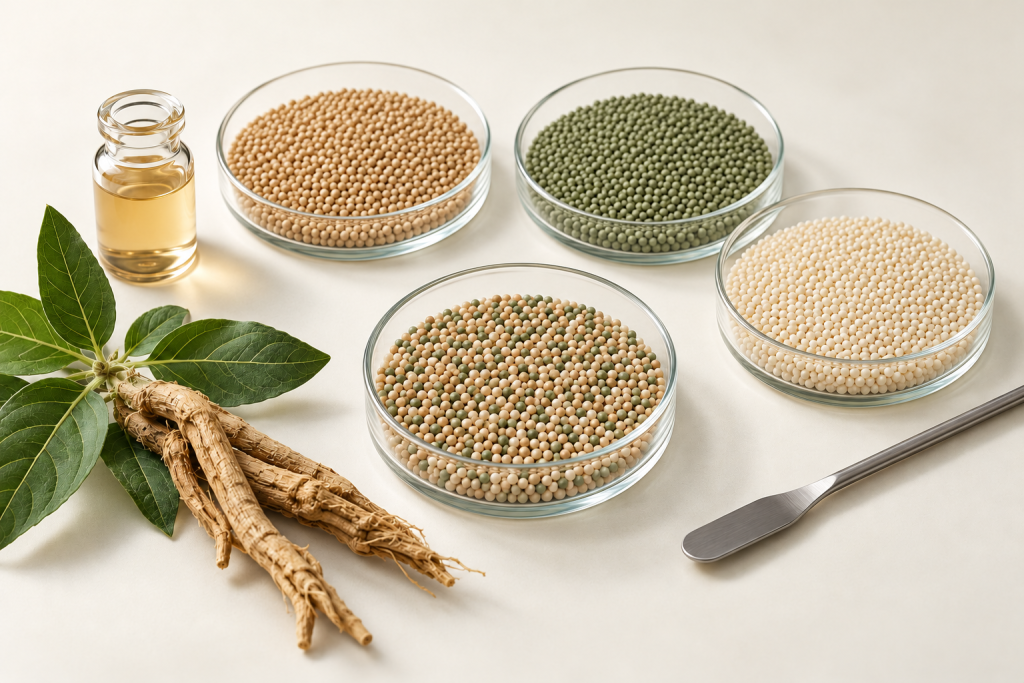
Ashwagandha, or Withania somnifera, is a plant used in Ayurvedic tradition that is attracting considerable interest in the nutraceutical industry for its adaptogenic properties: its ability to help the body adapt to physical and mental stress. Research into stress and sleep quality, alongside studies in other areas of wellbeing, has made it an ingredient of particular interest to food supplement developers.
Choosing the right extract is only part of the picture: how it is formulated matters too. The dosage form can make a difference to release control, combinations with other ingredients and ease of use. This is the focus of Euronovis’ work on sustained-release ashwagandha pellets made with KSM-66®, with particular attention to sustained release.
We spoke to Francesco Cappitelli, Scientific and Technical R&D Consultant at Euronovis, about what makes this plant interesting and how pellet technology can expand the options available to formulators.
What is ashwagandha used for, and why is it attracting interest in food supplements?
“Ashwagandha is an adaptogenic plant: it helps the body adapt to external or emotional stimuli and to situations that require a physical and mental response. This is the starting point for understanding its applications.
Most studies focus on stress management, anxiety symptoms and difficulty falling asleep. But interest extends further: research also covers memory and cognitive function, immune support, endurance and recovery in sport, and male and female sexual wellbeing.
Of course, the evidence is not equally strong in every area. The findings on anxiety, stress and sleep, in particular, make this plant especially interesting from a formulation perspective.”
— A recent reference is the meta-analysis by Marchi et al., published in BJPsych Open in 2025. It reviews clinical studies involving people with mental disorders and reports favourable results, particularly for anxiety symptoms, with promising findings for stress and sleep as well. The authors highlight the need for larger, more consistent studies. [1] —
How does ashwagandha work for stress and sleep?
Its interest as a botanical ingredient lies in its ability to modulate the hypothalamic–pituitary–adrenal (HPA) axis, the main neuroendocrine system responsible for the stress response. One of the most widely studied biomarkers is cortisol, a glucocorticoid whose circulating levels tend to rise under environmental or emotional stress. Clinical studies of ashwagandha extracts report reductions in serum cortisol levels alongside improvements in stress-related measures.
The proposed mechanism is indirect and involves gradual modulation of GABA-mediated neurotransmission. The plant’s bioactive constituents, particularly withanolides, appear to have GABA-mimetic activity, enhancing signalling mediated by gamma-aminobutyric acid (GABA), the main inhibitory neurotransmitter in the central nervous system, and thereby reducing neuronal overactivity.
The rationale for using Withania somnifera also extends to sleep regulation. Ashwagandha is attracting growing interest as a nutraceutical ingredient for improving sleep quality and reducing the time it takes to fall asleep. Studies in which the extract was taken before bedtime have reported statistically significant reductions in serum cortisol and improvements of up to 46% in self-reported sleep quality scores. This effect appears to involve a mechanism distinct from the sleep-inducing action of benzodiazepines, which act as positive allosteric modulators of the GABA-A receptor. The proposed explanation instead centres on rebalancing the HPA-mediated stress response, with potential implications for both daytime physical and mental wellbeing and the quality of sleep at night.
Which ashwagandha extract does Euronovis use in its pellets?
“We have worked with KSM-66®, a dry extract obtained exclusively from ashwagandha roots. This is an important distinction: when discussing a botanical extract, we need to know which part of the plant was used and understand the characteristics of the raw material.
In one of the formulations developed with Euronovis’ R&D team, the extract content reaches 75%. The formulation challenge is to incorporate an appropriate amount of the active ingredient to meet customers’ requirements.”
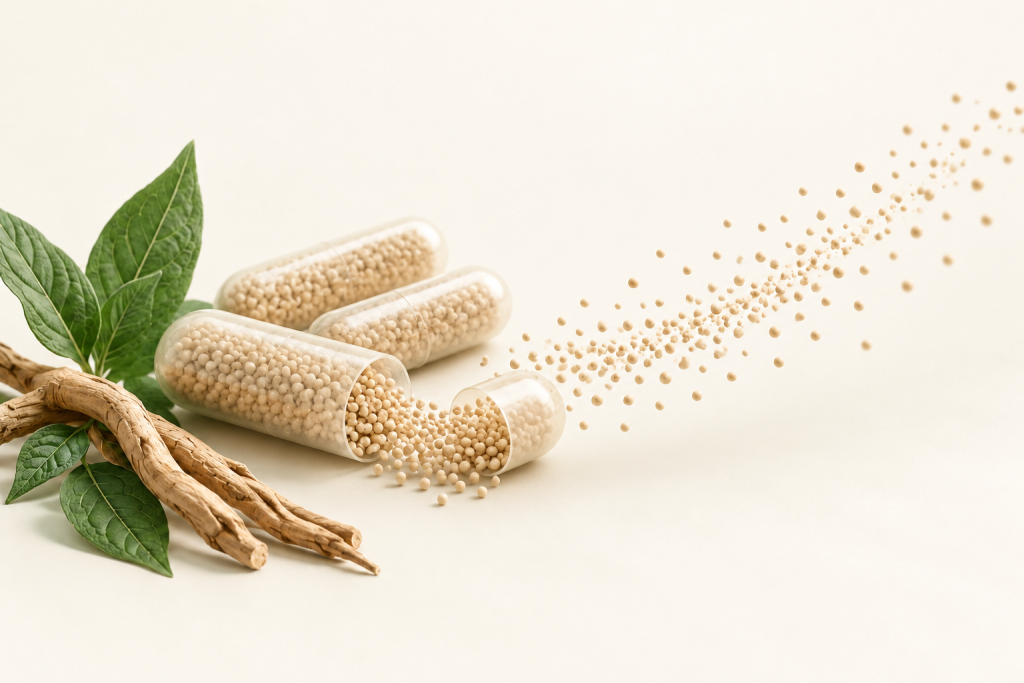
— What are pellets? Pellets are small, spherical or nearly spherical solid units, typically around 0.5–2 millimetres in size. Depending on the product’s characteristics, they can be used in capsules or stick packs, for example. From a pharmacokinetic perspective, they offer advantages in modulating three parameters: the rate, timing and site of release. — —
Why develop sustained-release ashwagandha pellets for sustained release?
“For an ingredient intended for stress management, it is useful to consider how its release can be spread over time. Stress is not necessarily confined to a single moment of the day. This is why we are interested in a formulation and dosage form that can prolong the release of the extract’s constituents.
Sustained release is one of the approaches we have focused on for ashwagandha, supported by substantial formulation research.”
What advantages can pellets offer over a conventional tablet?
“The defining feature is that the dose is distributed across many small units, which disperse throughout the gastrointestinal tract. This offers interesting opportunities to manage release and limit the concentration of the ingredient at a single site.
In sustained-release systems, dividing the dose across multiple units can also help reduce the risk of dose dumping: release that is faster than intended.
The aim is to make the product’s behaviour more consistent. Whether this translates into benefits for absorption or tolerability depends on the ingredient and the specific formulation.”
Can ashwagandha be combined with other ingredients in the same supplement?
“Yes, and this is one of the most interesting possibilities offered by pellets. We can combine different ingredients, each in its own pellet population and with its own release profile.
This means we can consider having one ingredient released more quickly and another more slowly within the same final dose. We do not necessarily have to give every component the same release behaviour.
For supplement formulators, this creates opportunities for customization. The combination must be designed around the ingredients, their compatibility and the product’s intended purpose.”
How can Euronovis help brands develop supplements with sustained-release ashwagandha?
“The starting point is to understand the product the customer wants to create. From there, we work on the extract content, pellet size, release profile and the format in which the pellets will be used.
Our role is to translate these requirements into a formulation. Our work on ashwagandha illustrates how knowledge of a nutraceutical ingredient can be combined with the possibilities offered by a technology to develop a solution suited to the customer’s project.”
Euronovis’ research into nutraceutical pellets
Euronovis’ R&D team develops pellet formulations containing botanical extracts, vitamins, minerals, amino acids, plant sterols and other ingredients of nutraceutical interest. Pellets are manufactured using extrusion and spheronisation, as with the ashwagandha formulations, or powder layering. They are supplied in bulk for subsequent incorporation into finished products.
Would you like to explore modified-release ashwagandha pellets or discuss the development of a new formulation? Contact the Euronovis team to tell us about your project.
[1] Marchi M et al. (2025). The effect of Withania somnifera (Ashwagandha) on mental health symptoms in individuals with mental disorders: systematic review and meta-analysis. BJPsych Open, 11(6), e260. https://doi.org/10.1192/bjo.2025.10885


